US markets have the demand depth and the valuation multiples. Canada has the power, the climate, and the cost base. For operators and investors, the interesting question is no longer either/or — it's where each workload belongs.
The largest data centre markets on the continent are American — Northern Virginia alone dwarfs any single Canadian market in inventory and demand. Yet Canadian digital infrastructure is drawing an outsized share of new institutional interest. The reason is not sentiment; it is economics. When you decompose the cost of building and operating a data centre, Canada wins on several of the largest line items, while the US wins on demand and exit value. Understanding that split is the key to a smart siting or acquisition decision.
Power cost and carbon
Power is the dominant operating cost of a data centre, and it is where Canada's advantage is most structural. Over 80% of Canadian electricity comes from non-emitting sources — hydro, nuclear, and wind. For operators with ESG commitments or hyperscalers making renewable claims, low-carbon power at scale is available in Canada without the premium or scarcity seen in many US markets. Alberta adds a further wrinkle: a deregulated market where large loads negotiate power purchase agreements directly with generators, including renewables.
Many high-demand US markets, by contrast, are increasingly supply-constrained at the transmission level, with multi-year interconnection queues for large loads and, in some regions, a heavier fossil-fuel generation mix.
Cooling and climate
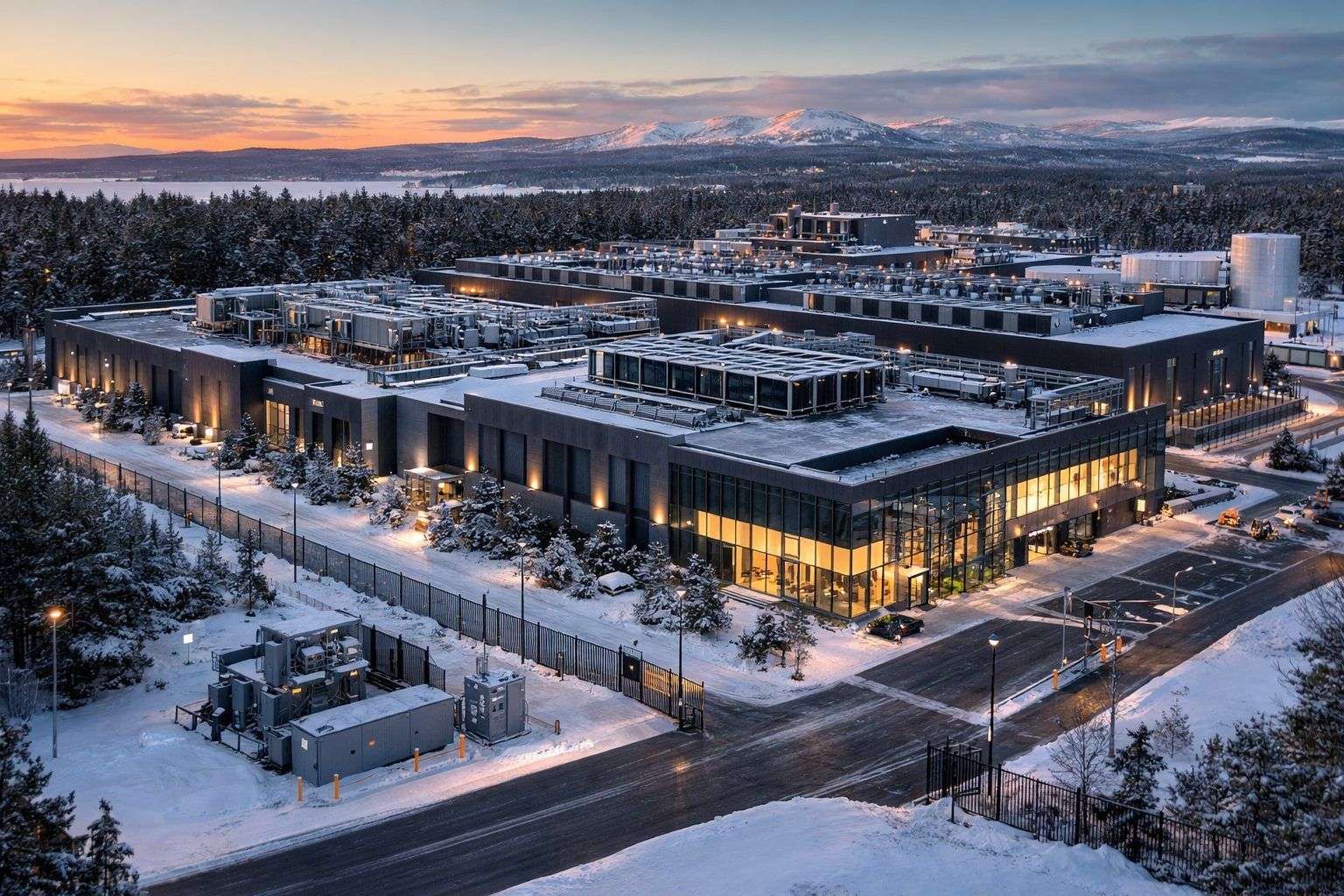
Cooling is the second-largest energy draw, and geography decides it. Canada's cold climate enables free-air economization for much of the year, letting facilities operate at a PUE below 1.2. Operators in Phoenix or Dallas cannot match that without significant capital and ongoing energy spend on mechanical cooling. Over a 15-year hold, the compounding difference in cooling energy is material.
Canada tends to win on power cost, carbon profile, cooling, land, and construction cost. The US tends to win on demand depth, USD revenue, and exit valuation multiples. The best strategies increasingly use both — matching each workload to the market whose economics fit it.
Land and construction cost
Land near heavy transmission is scarce and expensive in core US markets. In Canada — especially Alberta, Saskatchewan, and the corridors outside the Greater Toronto Area — comparable powered land is both available and materially cheaper. Construction costs generally run below saturated US markets as well, improving the residual value math on ground-up development.
Tax and incentives
Treatment varies by jurisdiction on both sides of the border. Alberta, for example, levies no provincial sales tax on equipment. US states compete aggressively with data-centre-specific tax abatements. The net position is genuinely site-specific and belongs in the underwriting rather than in a rule of thumb — but it rarely overturns the power-and-cooling advantage that anchors the Canadian case.
Data sovereignty and demand
This is where the two countries diverge most. Canada's data-residency laws and the federal sovereign-cloud initiative create a durable demand floor for in-country capacity from enterprises, financial institutions, healthcare, and government — demand that persists regardless of global market conditions. The US offers the opposite advantage: sheer demand depth and the deepest hyperscale and enterprise tenant base in the world, which supports higher valuations and faster lease-up.
Canada offers a structural cost and carbon advantage; the US offers demand depth and exit value. The winning move is often to use both.
Exit value
US-sited digital infrastructure has historically commanded higher valuation multiples, supported by deeper buyer pools and USD-denominated, contracted cash flows. For an investor focused on exit, that premium is real and belongs in the model alongside Canada's lower entry and operating costs.
When a cross-border strategy wins
For a growing number of operators, the answer is not Canada or the US but a portfolio that uses each for what it does best:
- Latency-sensitive, demand-driven workloads near US population and enterprise centres.
- Power-hungry, cost-sensitive workloads — training clusters, batch AI, cold storage — in low-cost, low-carbon Canadian markets.
- Sovereign and regulated workloads in-country in Canada to satisfy data-residency requirements.
- USD revenue as a natural hedge for Canadian operators expanding south.
Executing across both jurisdictions means navigating two regulatory environments, two utility processes, and cross-border deal structuring. PowerSite advises Canadian operators expanding into US markets and investors deploying capital into Canadian assets — and, through our development partnership, can deliver the build on either side of the border.
PowerSite Data Centre Group advises investors, operators, tenants, and landowners on data centre land, leasing, acquisitions, and development across Alberta, Ontario, Saskatchewan, and the United States. Submit a project brief or download our free Site Selection Checklist.